An overview of psychedelic + related compounds, including proposed mechanisms of action, physical and physiological risks, and investigational clinical applications.
The term “psychedelics” is broadly used to describe substances that can alter a person’s perception, mood, and cognitive processes. Researchers group psychoactive compounds into categories based on shared properties such as chemical structure, mechanism of action, and subjective effects. Compounds commonly studied in clinical research fall into three main categories: classical psychedelics, dissociatives, and entactogens/empathogens.
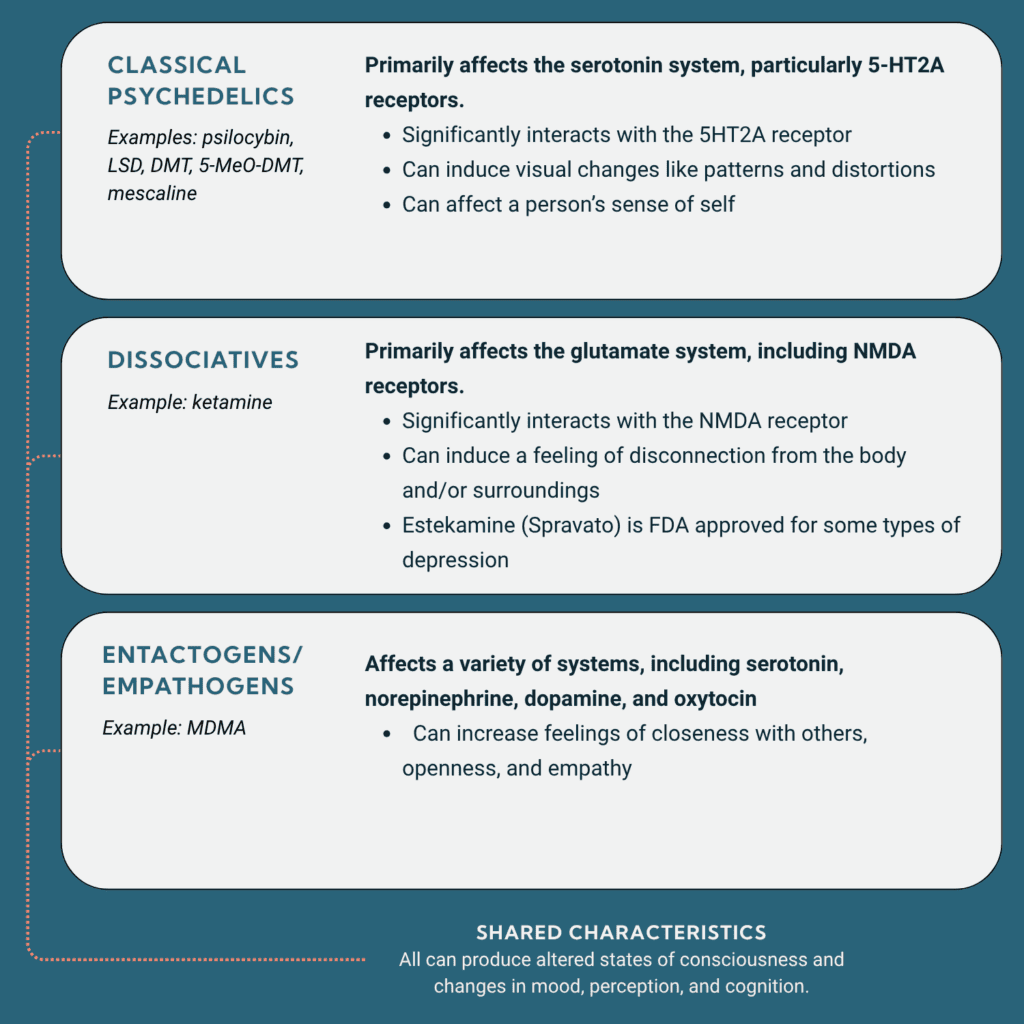
Neurobiology of the compounds
Generally, these investigational compounds interact with neurotransmitter systems, like serotonin receptors. These interactions can induce acute effects of psychedelics, such as alterations in thought processes, mood, and perception. Ongoing research is examining how these compounds are linked to biological changes that support clinical applications for indications like depression and PTSD:
- Neuroplasticity: Adaptations of the brain’s functional connectivity and structure
- Neurogenesis: Formation of new neurons (brain cells)
- Synaptogenesis: Creation of new synapses (connections between neurons to send signals)
Compounds being studied
Studies have demonstrated important characteristics of psychedelics and related compounds. Below is a summary of the available knowledge of compounds that are commonly administered in clinical trials.
| Compound | Onset and duration of action | Possible Psychological Effects | Possible Physical Effects | Areas of research | Contraindications and risks |
| Psilocybin A classical psychedelic found naturally in 100+ Psilocybe mushrooms and can be synthesized. | Effects generally begin within about 20-40 minutes, with peak effects around 60-90 minutes. Depending on dose and other factors, effects can last 4-6 hours. | Altered state of consciousness, changes in concept of self, affect, sense of time, visual & auditory distortions, hypersensitivity to touch, light, & sound. | Headache, nausea, fatigue, insomnia. | Psilocybin is being studied for MDD, PTSD, demoralization/ end of life distress, and mental health challenges associated with advanced illness. | Psilocybin should not be combined with MAOIs. For those with complex trauma, unprocessed emotions may arise. There is a risk of fear, despair, confusion, paranoia, delusions, and dissociation, which could require support and processing. Symptoms may worsen after the dosing experience. |
| 5-MeO-DMT A fast-acting classical psychedelic naturally occurring in certain plants and animal secretions and can be synthesized. | Effects can begin very rapidly and can last about 15-30 minutes, although duration can vary. | Altered state of consciousness, feelings of awe, visual and auditory distortions. | Increased heart rate and blood pressure. | 5-MeO-DMT is being studied for MDD and TRD. | 5-MeO-DMT should not be combined with MAOIs. The experience can be overwhelming and cause fear, although transient. There is a risk of traumatic flashbacks and reactivations. |
| LSD A classical psychedelic that is synthesized from compounds associated with ergot, a naturally occurring fungus. | Effects may begin within approximately 20-90 minutes, with peak effects occurring after about 2-4 hours. Duration depends on dose and other factors and can generally last 6-12 hours. | Altered state of consciousness, enhanced capacity for introspection, sense of bliss, trust, & openness, altered perception of time. | Increased heart rate, blood pressure, and body temperature. | LSD is being studied for GAD, depression, cluster headaches. | LSD carries a risk of traumatic flashbacks and reactivations. There is a possibility LSD can trigger schizophrenia in predisposed patients. |
| Ketamine A non-classical psychedelic classified as a dissociative. Ketamine has established medical uses. | Generally, timing depends on dose and route of administration. Effects may have a rapid onset with an average duration of 40-70 minutes. | Altered state of consciousness, altered sense of space and time. | Nausea, vomiting, dizziness, double vision, drowsiness, blurred vision. | Ketamine is being studied for MDD, TRD, and PTSD. | Ketamine has a potential for abuse. There is a risk of dysphoria and confusion. |
| MDMA A non-classical psychedelic classified as an empathogen or entactogen. It is a synthetic, substituted amphetamine derivative with chemical similarities to stimulants and hallucinogens. | Effects may begin approximately within 30-45 minutes. Depending on dose, effects can last around 4-6 hours, with peak effects occurring approximately 1.25-2 hours after initial dose. | Altered state of consciousness, increased compassion and openness, enhanced communication and introspection. | Mild muscle tightness, nausea, decreased appetite, increased sweating, palpitations, or tachycardia. | MDMA is being studied for PTSD and adjustment disorder (AD). | MDMA has a moderate abuse potential. There is a risk of intense emotional response or distress. Symptoms may worsen after the dosing experience. |
AD: adjustment disorder, GAD: generalized anxiety disorder, MDD: major depressive disorder, PTSD: posttraumatic stress disorder, TRD: treatment-resistant depression
The compound is only one part of the process
Investigational compounds, when delivered in a structured and supervised way, may create opportunities for shifts in perspective that contribute to therapeutic outcomes. The effects of these compounds can be significant, but to support meaningful change, the psychedelic-assisted therapy model includes:
- The therapeutic alliance between the patient and their care team
- A safe and supportive physical environment
- A calm and open mindset
- Intentional preparation and integration
Research continues to examine not only what these compounds do, but how to provide support that is safe and effective for different individuals.
The information provided here is for educational purposes and does not constitute medical advice nor does it claim to be exhaustive or include all available information. Compounds remain investigational in the United States. Eligibility for clinical research depends on the requirements of a specific protocol.
Sources:
- Yu Z, Burback L, Winkler O, Xu L, Dennett L, Vermetten E, Greenshaw A, Li X-M, Milne M, Wang F, Cao B, Winship IR, Zhang Y and Chan AW (2024) Alterations in brain network connectivity and subjective experience induced by psychedelics: a scoping review. Front. Psychiatry 15:1386321. doi: 10.3389/fpsyt.2024.1386321
- Cameron, L. P., Benetatos, J., Lewis, V., Bonniwell, E. M., Jaster, A. M., Moliner, R., Castrén, E., McCorvy, J. D., Palner, M., & Aguilar-Valles, A. (2023). Beyond the 5-HT2A receptor: Classic and nonclassic targets in psychedelic drug action. Journal of Neuroscience, 43(45), 7472–7482. https://doi.org/10.1523/JNEUROSCI.1384-23.2023
- https://www.healthdirect.gov.au/lsd-acid
- Brennan W and Belser AB (2022) Models of Psychedelic-Assisted Psychotherapy: A Contemporary Assessment and an Introduction to EMBARK, a Transdiagnostic, Trans-Drug Model. Front. Psychol. 13:866018. doi: 10.3389/fpsyg.2022.866018
- Oram M. Efficacy and enlightenment: LSD psychotherapy and the Drug Amendments of 1962. J Hist Med Allied Sci. 2014 Apr;69(2):221-50. doi: 10.1093/jhmas/jrs050. Epub 2012 Aug 16. PMID: 22898355.
- https://nida.nih.gov/research-topics/psychedelic-dissociative-drugs#references
- https://www.sciencedirect.com/topics/neuroscience/mdma
- González-Maeso, J., Weisstaub, N. V., Zhou, M., Chan, P., Ivic, L., Ang, R., Lira, A., Bradley-Moore, M., Ge, Y., Zhou, Q., Sealfon, S. C., & Gingrich, J. A. (2007). Hallucinogens recruit specific cortical 5-HT(2A) receptor-mediated signaling pathways to affect behavior. Neuron, 53(3), 439–452. https://doi.org/10.1016/j.neuron.2007.01.008
- Stocker, K., & Liechti, M. E. (2024). Methylenedioxymethamphetamine is a connectogen with empathogenic, entactogenic, and still further connective properties: It is time to reconcile “the great entactogen-empathogen debate”. Journal of psychopharmacology (Oxford, England), 38(8), 685–689. https://doi.org/10.1177/02698811241265352
- Inserra A., De Gregorio D., Gobbi G. Psychedelics in Psychiatry: Neuroplastic, Immunomodulatory, and Neurotransmitter Mechanisms. Pharmacological Reviews, 73, 202-277
- https://psychedelics.berkeley.edu/substances/
- https://www.dea.gov/sites/default/files/2025-01/Ecstasy-MDMA-2024-Drug-Fact-Sheet.pdf
- MacCallum, C. A., Lo, L. A., Pistawka, C. A., & Deol, J. K. (2022). Therapeutic use of psilocybin: Practical considerations for dosing and administration. Frontiers in psychiatry, 13, 1040217. https://doi.org/10.3389/fpsyt.2022.1040217
- https://www.camh.ca/en/health-info/mental-illness-and-addiction-index/lsd
- https://www.sunstonetherapies.com/psychedelic-therapy/#what